Workplace Accommodations for Autistic Adults: A Practical Guide
The hum of fluorescent lights feels like a siren, casual small talk drains your social battery before lunch, and you're constantly trying to decode unwritten office rules. If this sounds familiar, you're not alone in navigating the workplace as a potentially autistic adult. A common question we hear is, "Can I get accommodations without a formal diagnosis?" The path to a better work life begins with self-understanding, and clarifying your traits with our free, confidential autistic spectrum test is a powerful first step.

Understanding Your Workplace Rights and Needs as an Autistic Adult
ADA and Workplace Protections for Neurodivergent Employees
The Americans with Disabilities Act (ADA) protects autistic employees against discrimination and requires employers to provide "reasonable accommodations." This isn't about asking for special treatment; it's about creating an environment where you can perform at your best. Common accommodations include:
- Modified workspaces (e.g., noise-canceling headphones or a desk in a quieter area)
- Adjustments to job responsibilities or communication styles
- Permission to use subtle stim tools (e.g., fidget rings)
While formal diagnosis is not a prerequisite for ADA protection, understanding and articulating your needs is. A high score from our online autistic test can provide the preliminary insights and language to help you advocate for yourself.
Translating Your Autistic Test Results into Workplace Strengths
Many autistic traits translate into exceptional workplace assets when properly supported:
- Detail orientation for tasks requiring precision and quality control
- Deep focus for complex, long-term projects that others find daunting
- Pattern recognition for identifying trends and solving intricate problems
Use your AI-driven report to identify your specific strengths. You can then frame your accommodation requests around maximizing these assets for the company's benefit.
Understanding your rights is foundational, but applying that knowledge to your physical environment can bring immediate relief. Let's explore how to create a workspace that works with your sensory profile, not against it.
Sensory Accommodations for the Modern Workplace
For the estimated 85% of autistic adults with sensory sensitivities, an average office can feel like an obstacle course. Overwhelming lights, disruptive background chatter, and even the texture of the office carpet can hinder productivity and well-being.
Creating a Sensory-Friendly Workstation Setup
-
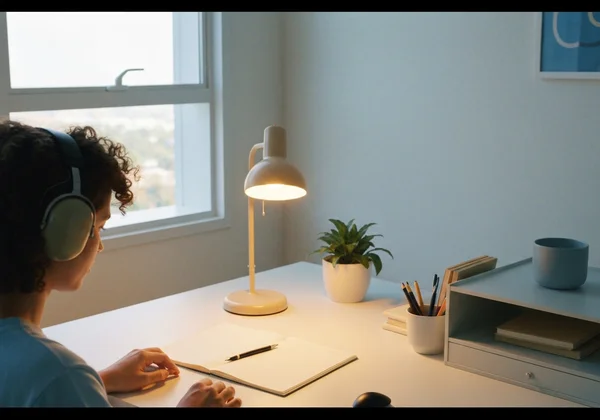
Lighting: Request permission to turn off overhead fluorescent lights and use a desk lamp with a warm-toned bulb instead.
-
Sound: Advocate for noise-canceling headphones or a desk relocation away from high-traffic areas like the kitchen or copier.
-
Textures: If possible, bring in a more comfortable chair or a small, non-distracting rug to place under your desk.
Navigating Overstimulating Office Environments
- Identify escape routes: Before a high-sensory day, locate a quiet room, empty conference room, or even a peaceful outdoor bench you can use for a quick reset.
- Schedule strategically: If possible, schedule demanding tasks like client calls or team meetings during times of the day when the office is naturally quieter.
- Build a sensory toolkit: Keep a small bag at your desk with items like sunglasses for harsh lighting, earplugs, and a favorite textured object to ground yourself.
Pinpointing your specific sensory triggers is key to advocating for the right changes. If you're unsure where to start, gaining insights from an autistic traits test can help you identify patterns and build a personalized toolkit for sensory regulation.
Once your physical space is more manageable, the next hurdle is often social interaction. Navigating communication and managing your energy are crucial for long-term success and well-being.
Social Communication Strategies at Work
You can thrive professionally without exhausting yourself trying to be someone you're not. The key is to find strategies that honor your natural communication style.
Direct Communication Approaches for Neurodiverse Teams
- Use email or instant messaging for nuanced discussions, as it allows you time to process and formulate a response.
- Request clear, agenda-driven meetings to help manage expectations and reduce the need for unpredictable small talk.
- Suggest sending written summaries after verbal discussions to ensure everyone is on the same page and to avoid misinterpretation.
Managing Social Energy and Professional Masking
-
Manage your social battery: Think of your energy as a finite resource. Identify which interactions (like team-building events or unstructured meetings) drain it the most and schedule recovery time afterward.
-
Create an energy budget: Just like a financial budget, track what drains you and what recharges you. Knowing that a 10-minute chat by the coffee machine costs you an hour of focused work later can help you set boundaries.

With strategies for your environment and interactions in place, the question of disclosure often comes up. Deciding if, when, and how to talk about your autistic traits with your employer is a personal choice that requires careful consideration.
Disclosure and Accommodation Request Strategies
Disclosing is a deeply personal decision with no one-size-fits-all answer. Your approach should be strategic and tailored to your workplace culture and relationship with your manager.
When and How to Disclose Your Autistic Traits at Work
| Scenario | Best Approach |
|---|---|
| You have obvious sensory needs | Disclose selectively and focus on the solution (e.g., "I focus much better with natural lighting instead of fluorescents.") |
| You're seeking formal accommodations | Submit a documented request through HR, referencing ADA compliance and focusing on performance benefits. |
| You have a trusted manager | Frame the conversation around neurodiversity and how you can best contribute to the team's goals. |
Sample Accommodation Request Letter Template
Dear [Manager's Name or HR Representative],
I am writing to request reasonable accommodations under the ADA to help me perform my role as [Your Role] to the best of my ability. I have certain traits, including [describe relevant traits, e.g., "sensitivity to auditory overstimulation" or "a need for direct, written instructions"], that can be supported with minor adjustments.
I propose the following solutions:
- Option 1: [Specific accommodation, e.g., "Use of noise-canceling headphones in the open office."]
- Option 2: [Alternative solution, e.g., "Relocating my desk to the quieter corner of the office."]
I am confident that these changes will enhance my focus and productivity. Thank you for your commitment to an inclusive and supportive workplace.
Sincerely, [Your Name]

Use insights from your AI-powered autistic analysis to tailor this script with precision and confidence.
Your Path to a More Supportive Work Environment
Your path to a more supportive work environment isn't about changing who you are—it's about creating the conditions for you to thrive. It starts with deep self-knowledge to understand your needs, awareness of your legal rights to feel secure, and strategic communication to advocate for yourself effectively. Gaining clarity on your traits through tools like our autistic spectrum testing is a crucial part of this journey.
Ready to harness your unique strengths in the workplace? Unlock actionable insights tailored to your neurotype with our free, confidential screening tool. Take the first step toward a better workday.
Frequently Asked Questions About Workplace Accommodations for Autistic Adults
What are my legal rights to workplace accommodations as an autistic adult?
Under the Americans with Disabilities Act (ADA), autistic adults are entitled to reasonable accommodations that address specific workplace barriers. These can include modified schedules, assistive technology, or adjusted communication methods. While a formal diagnosis is not legally required to request an accommodation, you do need to articulate the need. Your free autistic test report can be a useful tool for identifying and describing those needs.
How do I explain my need for accommodations to my employer?
Frame your requests around productivity gains and positive business outcomes, not limitations. For example, instead of saying "The noise is too much for me," try "I've found that when I use noise-canceling headphones, I can complete my data analysis tasks with 20% greater accuracy."
Can I be fired for requesting autism-related workplace accommodations?
No. Retaliation for a good-faith accommodation request is illegal under federal law. It is always wise to document all communications regarding your request in writing (e.g., via email) and consult an employment lawyer if you believe you are facing retaliation.
Get clarity on your traits first: Explore our confidential autistic test →