On the Spectrum Meaning A Plain-English Guide to Autism Spectrum Language
If you are searching for on the spectrum meaning, you are probably trying to understand a phrase that can sound simple but carry a lot of emotional weight. In most health and education contexts, saying someone is "on the spectrum" means they may be autistic or may show traits associated with autism spectrum disorder. It is not a casual personality label, a rank from "mild" to "severe," or a shortcut for judging intelligence. If the phrase feels personally relevant, an autism trait screening overview can help you organize observations before deciding whether a formal evaluation conversation makes sense.
What Does "On the Spectrum" Mean?
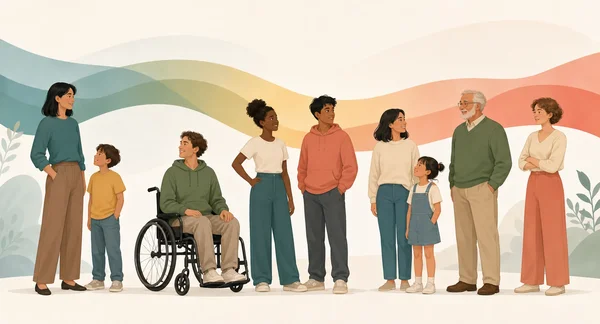
"On the spectrum" usually means "on the autism spectrum." Autism spectrum disorder is a neurodevelopmental pattern involving differences in social communication, interaction, routines, interests, sensory processing, learning, movement, or attention. The word "spectrum" matters because autistic people are not all the same. One person may speak fluently but struggle with sudden changes. Another may communicate with limited speech or an assistive device. Someone else may have strong pattern recognition and intense interests while needing support in noisy or unpredictable settings.
The phrase is best understood as a broad umbrella, not a single checklist. It points to a pattern across several areas of life. It also leaves room for strengths, support needs, masking, culture, age, and co-occurring experiences such as anxiety or ADHD. A person can have traits that resemble autism without meeting the criteria used in a formal clinical assessment, so the phrase should be used with care.
Spectrum does not mean a straight line
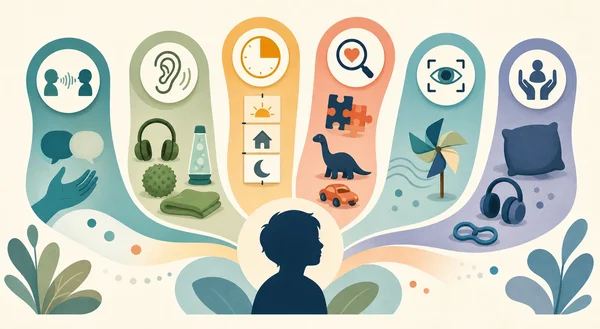
Many people picture a line from "not autistic" to "very autistic." That picture is misleading. A better image is a profile with several dimensions. Social timing, sensory sensitivity, need for routine, communication style, attention switching, detail focus, and emotional regulation can each vary. Support needs can also change by setting. A person who manages well at home may feel overwhelmed at work, school, parties, or travel.
It is not a value judgment
Being on the spectrum does not mean someone is less capable, less caring, or less intelligent. It means their nervous system may process social, sensory, and cognitive information differently. Some autistic people need substantial daily support. Others live independently, work, parent, study, build relationships, and still benefit from accommodations or clearer communication. The useful question is not "how high or low is this person?" It is "what patterns are present, and what support would help?"
On the Spectrum Meaning in Adults, Children, and ADHD Searches
Searches such as "what does on the spectrum mean in adults" and "on the spectrum meaning ADHD" often come from people comparing real-life patterns. Maybe an adult has always felt different in social settings. Maybe a parent notices a child has intense interests, sensory reactions, or trouble with transitions. Maybe someone with ADHD sees overlap in attention, routines, or emotional regulation and wonders if the words point to the same thing.
For adults, "on the spectrum" often refers to long-standing traits that were missed earlier. Adults may describe feeling socially exhausted, rehearsing conversations, taking language literally, needing recovery time after sensory overload, or building life around predictable routines. Some adults have learned to mask their differences so well that others only see stress, burnout, or "quirkiness." That does not make their experience less real.
For children, the phrase often comes up around development, communication, play, sensory reactions, repetitive behaviors, or intense preferences. A child on the spectrum may avoid eye contact, use fewer gestures, repeat phrases, line up objects, become distressed by small changes, or react strongly to sounds, textures, tastes, lights, or smells. A single sign does not settle the question. Patterns across time and settings matter.
ADHD does not automatically mean someone is on the autism spectrum. ADHD and autism are distinct neurodevelopmental patterns, although they can co-occur and share some features, such as attention differences, impulsivity, sensory sensitivity, restlessness, or executive-function challenges. The distinction usually depends on the broader pattern: autism centers more on social communication differences plus restricted or repetitive behaviors, interests, or sensory patterns; ADHD centers more on attention regulation, impulsivity, activity level, and executive-function patterns.
If you are comparing your own traits or a child's traits, an AQ-based self-reflection tool can be a structured way to notice patterns without treating a score as a final answer.

Common Traits People Mean by "On the Spectrum"
When people ask about "on the spectrum symptoms," they are usually looking for everyday examples. The word "symptoms" can sound medical and fixed, but many autistic people prefer "traits" or "characteristics." Traits can be challenging, neutral, or strengths depending on the setting.
A practical way to think about the common pattern is:
- Social communication differences: difficulty reading implied meaning, facial expressions, tone, small talk, group conversation, or social timing.
- Interaction differences: preferring parallel activity, needing more recovery time after social demands, or connecting deeply through shared interests.
- Repetitive or restricted patterns: routines, repeated movements, repeated phrases, focused interests, strong preference for sameness, or distress during sudden changes.
- Sensory differences: strong reactions to sound, light, smell, texture, food, crowds, or body sensations.
- Learning and attention differences: detail focus, uneven skill profiles, difficulty switching tasks, or unusual ways of solving problems.
People sometimes ask, "What are the 3 main symptoms of autism?" A more accurate answer is that autism is commonly understood through two core areas: social communication and interaction differences, and restricted or repetitive behaviors or interests. Sensory differences, attention differences, language patterns, movement, sleep, anxiety, and learning differences may also appear. That is why a thoughtful evaluation looks at the whole pattern rather than one sign.
Here is a simple reflection exercise:
- Write down the behavior or experience without interpreting it.
- Note where it happens: home, school, work, social events, online, or public places.
- Note what helps: predictability, quiet space, written instructions, sensory tools, direct language, breaks, or extra time.
- Look for patterns across weeks or months, not just one stressful day.
This exercise is not meant to label anyone. It helps turn a vague phrase into concrete observations that can be discussed with a qualified professional if needed.

What "On the Spectrum" Does Not Mean
Because the phrase is common online, it is sometimes used loosely or even unkindly. That is where confusion grows.
"On the spectrum" should not be used as an insult for someone who is awkward, blunt, intense, introverted, detail-focused, or socially different. It should not be used to mock a person who misses a joke, dislikes noise, prefers routines, or talks passionately about one topic. Autism is not slang for "weird." It is a meaningful neurodevelopmental category and a lived identity for many people.
"High on the spectrum" is also imprecise. People may use it to mean "has many traits," "needs more support," or "seems very autistic," but those meanings are not the same. Support needs can vary by environment. A person who appears fluent and independent may still need serious accommodations. Another person who needs communication support may also have strong preferences, relationships, humor, and expertise that outsiders miss.
"A bit on the spectrum" can be confusing too. Some people use it to describe mild or partial traits, but it can minimize the real experience of autistic people. A better phrase is more specific: "I notice sensory sensitivity," "I struggle with transitions," "I prefer direct communication," or "I wonder whether these long-standing patterns are autism-related."
"Love on the Spectrum" usually refers to a media title about dating and autistic people. It does not change the meaning of the phrase itself. In relationships, being on the spectrum does not mean someone cannot love, communicate, or build intimacy. It may mean that directness, sensory comfort, predictable plans, and explicit expectations matter more.
A Gentle Next Step If the Phrase Feels Personal
The on the spectrum meaning becomes most useful when it helps someone move from worry to clearer observation. If the phrase keeps showing up in your searches because it feels connected to your life, slow the question down. Ask what you are noticing, how long it has been present, where it causes friction, where it brings strengths, and what kind of support would make daily life easier.
You might explore guided autism self-reflection as a low-pressure way to organize your thoughts. Treat any online screener as an educational starting point, not a clinical decision. If the patterns affect school, work, relationships, safety, parenting, or mental health, consider speaking with a qualified professional who can look at development, history, context, co-occurring factors, and support needs.
The goal is not to force a label onto every difference. The goal is to understand the person more accurately. For some people, that understanding leads to formal assessment. For others, it leads to better routines, clearer communication, sensory supports, workplace accommodations, or kinder self-language. Either way, the phrase is most helpful when it opens a thoughtful conversation rather than closing one.
FAQ
What does it mean if someone is on the spectrum?
It usually means the person is autistic or may have autism-related traits. The phrase points to a range of social communication, sensory, routine, interest, learning, and support patterns. It should be used respectfully and with attention to the person's own language preferences.
What does "on the spectrum" mean in slang?
In slang, people sometimes use it to describe someone who seems awkward, intense, blunt, or unusual. That casual use can be disrespectful because it turns autism into a joke or insult. In careful language, "on the spectrum" means connected to the autism spectrum, not simply quirky or socially uncomfortable.
Does having ADHD mean you are on the spectrum?
No. ADHD does not automatically mean someone is on the autism spectrum. ADHD and autism can overlap and co-occur, but they are not the same pattern. If both seem possible, the useful next step is to compare the full history and day-to-day traits with a qualified professional.
What does on the spectrum mean in adults?
In adults, it often refers to long-standing autism-related traits that may have been missed earlier. Examples can include social exhaustion, sensory sensitivity, difficulty with sudden changes, intense interests, literal language, masking, or burnout from trying to appear typical.
What does on the spectrum mean for a child?
For a child, it may refer to developmental and behavioral patterns such as differences in communication, play, social interaction, routines, repetitive behaviors, sensory reactions, or attention. One behavior alone is not enough. Patterns over time and across settings are more meaningful.
What is the difference between autism and autism spectrum disorder?
In current everyday use, "autism" and "autism spectrum disorder" often refer to the same broad category. The word "spectrum" emphasizes that autistic people can have very different strengths, challenges, communication styles, sensory needs, and levels of support.
What does high on the spectrum mean?
People use that phrase in different ways, so it is not very precise. It may be better to say what you actually mean, such as "needs more daily support," "has strong sensory sensitivity," or "shows many autism-related traits." Specific language is kinder and more useful.
How would you explain on the spectrum meaning in Chinese?
A careful English-to-Chinese explanation would focus on the idea of being on the autism spectrum, not on slang or insult. The important point is that the phrase refers to autism-related neurodevelopmental traits and should be used with respect, context, and humility.