Level 1 ASD Meaning: Symptoms, Support Needs, and Next Steps
Level 1 ASD is the support-needs label used when an autistic person needs support, but not the most intensive level of autism support. It does not mean "barely autistic," and it does not describe intelligence, kindness, potential, or how hard someone is trying. It is a clinical shorthand for how autism-related traits may affect social communication, flexibility, sensory life, routines, and daily participation.
If you are reading about level 1 ASD because something feels familiar, start with education rather than pressure. An educational autistic traits screener can help you organize observations for self-reflection, but it is not a replacement for a formal clinical assessment.

What Does Level 1 ASD Mean?
ASD means autism spectrum disorder. In DSM-5 language, autism is described through two broad areas: persistent differences in social communication and social interaction, plus restricted or repetitive behaviors, interests, routines, or sensory patterns. The "level" is a support-needs specifier. Level 1 is commonly summarized as requiring support, Level 2 as requiring substantial support, and Level 3 as requiring very substantial support.
That wording matters. A level is not a score on a personality quiz. It is not a ranking of worth. It is also not a fixed forecast. Support needs can look different at school, work, home, relationships, health care visits, or during periods of stress and burnout. Someone may appear independent in a predictable job but need meaningful help with transitions, sensory overload, executive functioning, or unclear social expectations.
Level 1 ASD is sometimes called "mild autism," but that phrase can be misleading. Mild to an observer can still be exhausting for the person living it. A person may speak fluently, succeed academically, or hold a job while spending huge energy masking, scripting conversations, recovering from sensory overload, or keeping routines from falling apart.
Level 1 ASD Symptoms People Often Notice
Level 1 ASD symptoms are usually most visible when social, sensory, and flexibility demands pile up. The pattern is more important than any single trait.
In social communication, a person may find small talk draining, miss implied meaning, speak in a direct or detailed style, need extra time to respond, or feel unsure how to begin and end conversations. Some people want friendship but struggle with the unspoken timing, tone, or body-language rules others seem to absorb automatically.
In routines and interests, a person may rely on predictable plans, feel distressed by sudden changes, return intensely to preferred topics, or use repeated behaviors to regulate attention and emotion. These patterns can be strengths when they support focus, honesty, memory, or deep expertise. They can become harder when an environment demands constant switching.
Sensory differences are also common. Sounds, lights, textures, smells, crowds, or touch may feel stronger than expected. Some people seek sensory input, such as pressure, movement, or familiar objects. Others avoid stimulation because it quickly becomes overwhelming.
Level 1 ASD in Adults, Women, and Masked Presentations
Level 1 ASD in adults can be harder to recognize because many adults have built coping systems over years. They may rehearse conversations, imitate social styles, force eye contact, hide stimming, or schedule recovery time after ordinary events. From the outside, things may look fine. Internally, the cost can be fatigue, anxiety, shutdowns, irritability, or a sense of always performing.
Adult women and gender-diverse people are often discussed in this context because their autistic traits may be missed when they are socially motivated, verbally fluent, or skilled at camouflage. Their interests may also look socially acceptable, so the intensity is overlooked. The important point is not that autism has one female pattern. It is that support needs can be hidden by expectations, learned scripts, and years of adapting.
For adults, useful clues often come from lifetime patterns: childhood sensory sensitivities, long-standing social confusion, strong need for routine, unusually deep interests, burnout after social demands, and repeated feelings of being "too much" or "not enough" in ordinary settings. A careful professional assessment may consider history, current functioning, co-occurring conditions, and the person's own account.
Level 1 ASD vs Level 2 ASD
The difference between level 1 ASD vs Level 2 is mainly the amount and visibility of support needed, not whether one person is "more real" than another. At Level 1, difficulties may be noticeable without support, but the person may use language, routines, tools, and learned strategies to participate in many settings. At Level 2, social communication differences and restricted or repetitive behaviors usually require more substantial support across daily life.
For example, a Level 1 adult might manage a meeting with preparation but feel depleted afterward. A Level 2 person may need more direct help to communicate needs, shift activities, or manage distress in the same setting. Both people deserve individualized support. The level is only one part of the picture.
This is also why autism trait screening can support self-reflection before a clinical conversation. A screener can help you notice patterns, but it cannot decide which support level fits a person. That requires broader context.
Is Level 1 ASD the Same as Asperger's?
Level 1 ASD is not exactly the same as Asperger's, although there is overlap in everyday conversation. Asperger's syndrome was an older diagnostic label used for some people who had autistic traits without early language delay or intellectual disability. DSM-5 folded Asperger's and several related labels into autism spectrum disorder.
Some people still identify strongly with Asperger's because it shaped their history, records, or community identity. Others prefer autistic, autism spectrum, or ASD. In current clinical language, a person previously described with Asperger's may now be described as having ASD, often with Level 1 support needs, but the terms are not perfect one-to-one replacements.
Level 1 ASD and ADHD: Why They Can Be Confused
Level 1 ASD and ADHD can overlap in daily life. Both may involve executive-function challenges, attention differences, emotional intensity, restlessness, and difficulty keeping up with school or work demands. A person may also have both.
The distinction is often found in the pattern. ADHD is commonly associated with attention regulation, impulsivity, activity level, and follow-through. ASD is more centered on social communication differences, sensory patterns, restricted or repetitive behaviors, and a need for predictability. In real life, these can interact. A person may crave routine because of autism and still struggle to maintain it because of ADHD-like attention patterns.
Instead of forcing a quick either-or answer, it can help to document examples: What situations create stress? What supports help? Are the hardest moments social, sensory, attention-based, transition-based, or all of the above? Those notes can make a later assessment more useful.

Practical Support for Level 1 ASD
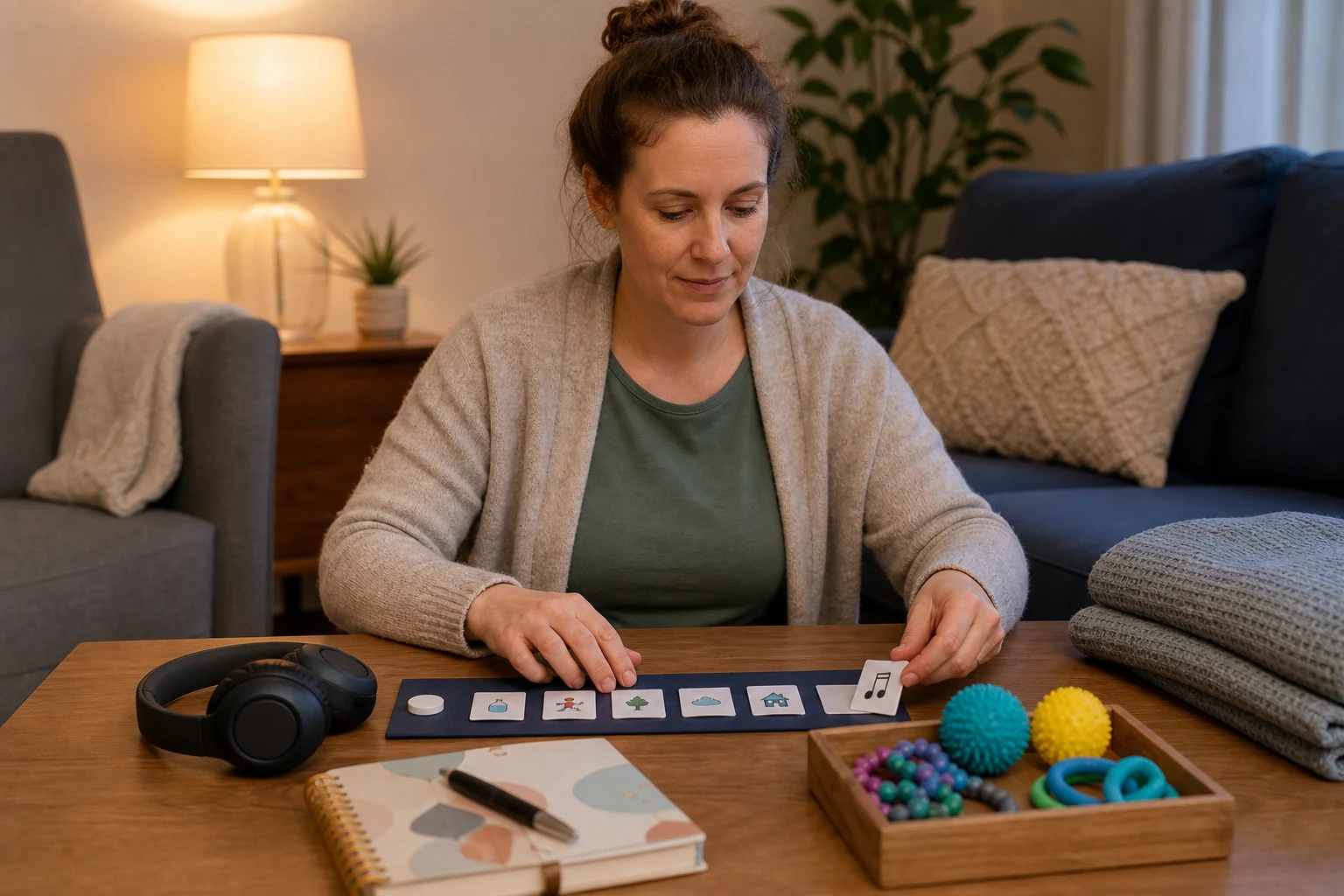
Support for Level 1 ASD is often about reducing hidden load. It may include clearer communication, predictable routines, sensory adjustments, written instructions, transition warnings, quiet recovery time, flexible work or school expectations, and help with planning.
At home, a support plan might include shared calendars, low-stimulation spaces, meal or chore routines, and direct conversation about needs. At school or work, it might include written expectations, agenda previews, noise reduction, task breakdowns, or permission to communicate in writing when speech feels hard. In relationships, support may look like explicit plans, honest language, and respect for downtime.
The goal is not to erase autistic traits. The goal is to make life less dependent on constant masking and crisis-level effort. Many people also benefit from therapy, coaching, occupational therapy, speech-language support for pragmatic communication, peer groups, or accommodations, depending on age and needs.
When an ASD Level 1 Test Can Help
People often search for a level 1 ASD test when they want clarity quickly. It is better to think of online tools as structured reflection, not as a final answer. A questionnaire can help you gather language for traits, compare patterns across settings, and decide whether a formal assessment is worth exploring.
Before using any screener, keep three limits in mind. First, online results can be affected by masking, mood, anxiety, ADHD, culture, reading style, and how you interpret questions. Second, a high or low score is not the same as a clinical diagnosis. Third, support needs are practical and contextual, so the most useful outcome may be a clearer list of examples rather than a label.
If you use a screener, write down what each answer reminds you of in real life. Specific examples such as "I need a full day to recover after group events" or "I cannot focus when lighting flickers" are more useful than vague worry.
Turning Level 1 ASD Insight Into Next Steps
Level 1 ASD is best understood as a support-needs framework, not a ceiling. If the term fits your experience, your next step can be gentle and practical: learn the language, notice your patterns, try one support at a time, and consider professional guidance if traits are affecting relationships, work, school, parenting, or mental health.
You might begin with a short notes list: social situations that drain you, sensory triggers, routines that help, changes that are hard, strengths linked to focus or detail, and supports you already use. If you want a non-urgent way to organize those observations, structured AQ-based reflection can be a starting point for learning and conversation.
Level 1 ASD still needs support. The support may be quieter, more strategic, or less visible than people expect, but it can make daily life more sustainable.

FAQ
Does level 1 autism get better with age?
Autism itself is generally lifelong, but skills, self-understanding, environments, and supports can change a lot over time. Some people feel better as they learn their needs and build sustainable routines. Others feel more strain when adult responsibilities increase or masking becomes exhausting.
Is ASD Level 1 the same as Asperger's?
Not exactly. Asperger's was an older label, while ASD Level 1 is current support-needs language within the autism spectrum. Some people who once received an Asperger's label may now be described as having ASD with Level 1 support needs, but personal identity and clinical wording can differ.
Is ASD Level 1 a disability?
It can be. ASD is recognized as a developmental disability, and Level 1 means support is still needed. Whether a person qualifies for specific services, workplace accommodations, school supports, or disability benefits depends on local rules and how traits affect daily functioning.
Does Level 1 ASD need support?
Yes. Level 1 explicitly means requiring support. The support may involve sensory adjustments, clearer communication, executive-function tools, predictable routines, therapy, coaching, or formal accommodations. The right mix depends on the person and setting.
What is commonly seen in someone with Level 1 ASD?
Common patterns include social communication differences, strong interests, preference for routine, sensory sensitivity, direct communication, difficulty with transitions, and fatigue from masking. Not every person has every trait, and strengths often appear alongside challenges.
Is Level 1 ASD high-functioning?
Many people use "high-functioning" casually, but it can hide real support needs. Someone may look capable in one setting while struggling intensely in another. Level 1 ASD is more precise because it focuses on support needs rather than a broad impression of ability.
Can Level 1 ASD appear with ADHD?
Yes. ASD and ADHD can occur together, and their traits can overlap. Attention challenges, planning difficulties, sensory stress, and social fatigue may interact. A careful assessment can look at the full pattern instead of treating it as a simple either-or question.