Is Autism a Disability? A Clear Guide to Legal, Medical, and Everyday Meanings
Many people search "is autism a disability" because they are trying to make sense of several different questions at once. They may be asking about identity, school support, workplace accommodations, SSI, tax rules, SNAP, or whether autism is the same thing as a mental illness. The clearest answer is this: autism is a neurodevelopmental condition that can be considered a disability in many legal, educational, and support contexts, especially when autistic traits substantially affect daily life. That does not mean every autistic person describes themselves the same way, needs the same support, or should be reduced to a deficit label. If you are still organizing what traits you notice in yourself or someone you support, an autism traits screening starting point can help you turn broad concerns into clearer observations.
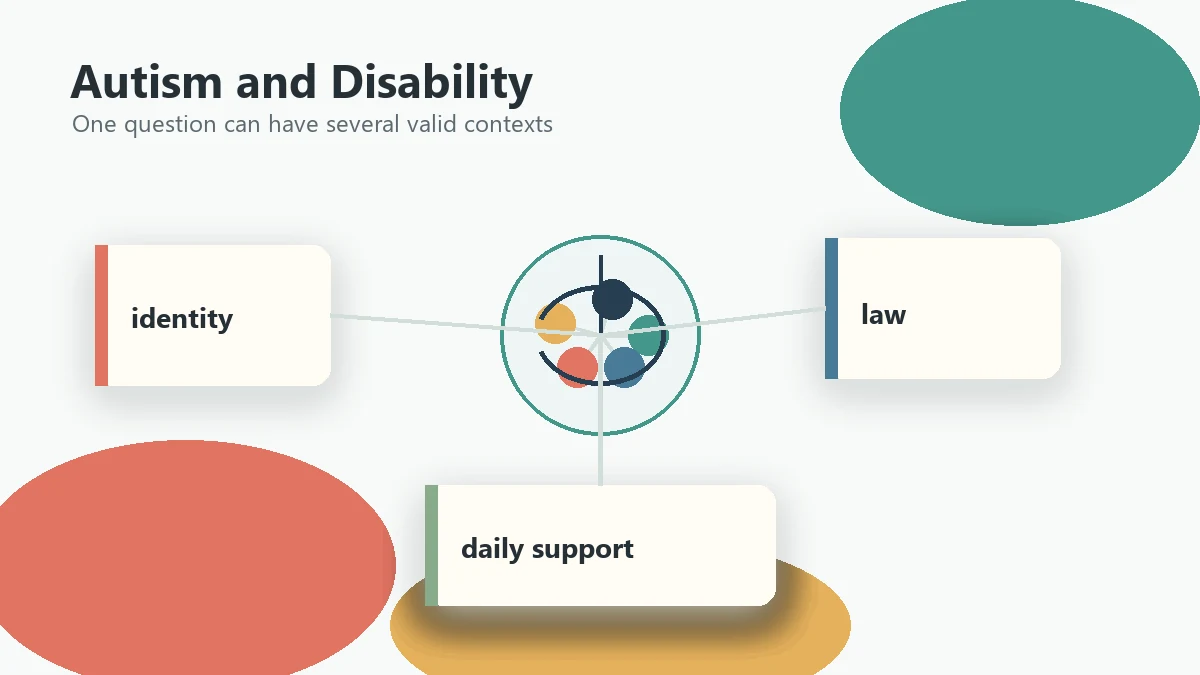
The Short Answer: Autism Can Be a Disability, but Context Matters
Autism can be a disability when it limits major life activities, creates meaningful support needs, or qualifies someone for protections or services under a specific rule. In everyday language, people may also use "disability" to describe the real impact of sensory sensitivity, communication differences, executive-function challenges, burnout, social misunderstanding, or the energy cost of masking.
At the same time, autism is a spectrum. One autistic person may need substantial help with communication, daily routines, or safety. Another may live independently, work, raise a family, and still need accommodations for sensory load, social expectations, or task switching. Both experiences can be valid. Disability status is not a measure of someone's worth, intelligence, personality, or potential.
This is why the answer to "is having autism a disability?" is often "yes in many contexts, but not always in the same way." The best question is usually more specific: disability for what purpose, under which rule, and based on what functional impact?
Autism Is a Developmental Disability, Not a Mental Illness
Autism is widely described as a developmental or neurodevelopmental condition because it relates to brain development and lifelong patterns in social communication, sensory processing, interests, routines, and behavior. It is not usually classified as a mental illness in the same sense as depression, anxiety disorders, or psychosis.
That distinction matters. Saying autism is not a mental illness does not mean autistic people cannot have mental health needs. Anxiety, depression, ADHD, sleep problems, and trauma can co-occur with autism, and those needs deserve careful support. But autism itself is not something that appears only after a period of typical development, and it is not a temporary episode to be treated away.
Some people prefer terms such as autistic person, neurodivergent person, or person on the autism spectrum. Others use the formal phrase autism spectrum disorder because it appears in clinical, school, insurance, and legal systems. Good informational writing can respect both realities: autism is a recognized condition with real support implications, and autistic identity is also part of many people's self-understanding.
Is Autism a Learning, Intellectual, Cognitive, or Physical Disability?
Autism can overlap with several disability categories, but it is not identical to all of them.
In the United States, a specific learning disability usually refers to difficulties in areas such as reading, writing, or math that are not better explained by other factors. Autism may affect learning, classroom participation, attention, language, sensory regulation, and social communication, but autism itself is not the same as dyslexia or another specific learning disability.
Autism is also not the same as intellectual disability. Some autistic people have intellectual disability, and some do not. Many autistic people have average or above-average measured intelligence while still having significant support needs in communication, daily living, sensory regulation, or flexible problem solving. This is one reason the phrase "high-functioning" can be misleading: it often hides the effort, exhaustion, and uneven skill profile behind a person's visible abilities.
Autism is not primarily a physical disability, though it can affect movement, coordination, eating, sleep, pain communication, and sensory experiences. It can also be described as a cognitive or developmental disability in some settings because it affects how information is processed, organized, and responded to.
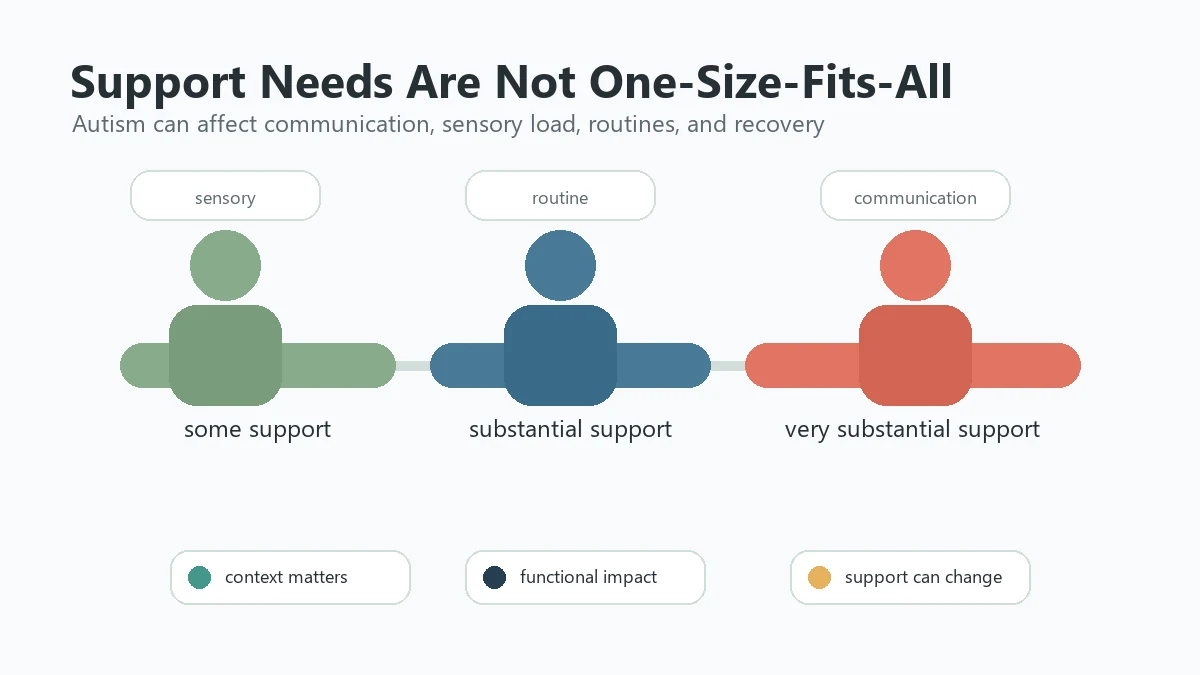
Is Level 1 or High-Functioning Autism Considered a Disability?
Level 1 autism can be considered a disability when the person's traits substantially affect major life activities or create support needs. The autism support levels often refer to the amount of support a person may need, with Level 1 commonly described as requiring support, Level 2 as requiring substantial support, and Level 3 as requiring very substantial support. These levels are not a simple ranking of someone's value, independence, or future.
"High-functioning autism" is still a common search term, but it is not always helpful. A person may speak fluently, perform well in school, or hold a job while still struggling with sensory overload, shutdowns, rigid routines, social misreading, transitions, or recovery time after demanding situations. In legal and support systems, the key issue is often functional limitation, not whether someone appears capable during a brief interaction.
If you are trying to describe these patterns before a school meeting, workplace conversation, or professional evaluation, an autism trait screener can be useful as an educational self-reflection tool. It cannot replace a full professional assessment, but it can help you notice which daily-life areas deserve closer attention.
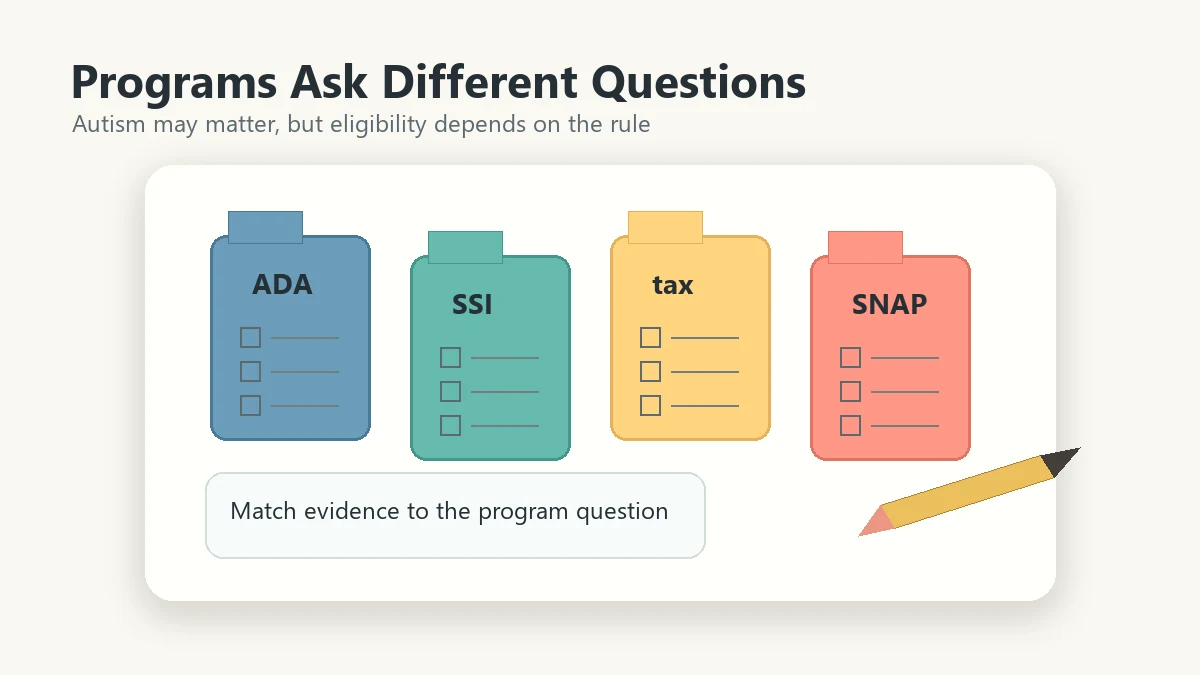
Autism Under the ADA, SSI, Tax, and SNAP Rules
In the United States, autism may be treated as a protected disability under the Americans with Disabilities Act when it substantially limits one or more major life activities. Major life activities can include communicating, learning, working, concentrating, interacting with others, and caring for oneself. The exact analysis depends on the person and the situation, so the practical question is not just "is autism a disability under ADA?" but "what barrier exists, and what reasonable accommodation would address it?"
For SSI, autism can qualify when the evidence shows severe functional limitations and the person also meets financial and program rules. Children and adults are evaluated differently, and there is no autism-specific check amount. Payment amounts can change by year, state supplement, income, living arrangement, and other benefits. A person can have autism and still be denied if the program's medical or financial standards are not met.
For tax purposes, autism by itself does not automatically create one universal tax result. The relevant issue is the specific IRS rule being used, such as dependent status, disability-related medical expenses, education expenses, or rules that refer to permanent and total disability. Families often need program-specific tax guidance because autism support costs and eligibility facts vary widely.
For SNAP, autism is not a simple automatic qualifier. SNAP rules may treat a household member as disabled if that person receives certain disability benefits or meets a listed program definition. Because SNAP is income- and household-based, the same autism diagnosis can lead to different outcomes in different families.
Outside the United States: UK, Japan, and Program-Specific Rules
Autism disability status also changes by country. In the UK, autism is commonly discussed under disability and equality frameworks when it has a substantial and long-term effect on normal day-to-day activities. That can matter for school support, workplace adjustments, and protection from discrimination.
In Japan, autism is often discussed within developmental disability support systems, but practical access to services can depend on local procedures, certificates, assessments, age, school or employment context, and municipal rules. Similar variation appears in many countries.
The lesson is simple: autism may be a disability in a broad sense, but benefits, accommodations, and legal protections are always tied to local definitions. If the question involves money, immigration, employment rights, school services, or legal forms, use official program guidance or a qualified local professional.
A Practical Way to Describe Support Needs
When people ask whether autism qualifies as disabled, they often need language for real-life impact. A practical description usually includes:
- communication needs, such as literal interpretation, processing time, or alternative communication;
- sensory needs, such as noise, light, texture, smell, crowds, or pain sensitivity;
- executive-function needs, such as transitions, planning, task initiation, or flexible problem solving;
- social and emotional load, such as masking, burnout risk, or recovery after demanding settings;
- daily living needs, such as eating routines, hygiene, transportation, money management, or safety awareness;
- strengths, such as deep focus, pattern recognition, honesty, memory for detail, or strong interest-based learning.
This balanced language is often more useful than arguing over a single label. It shows what support would actually change daily life while avoiding the idea that autism is only a list of problems.
How to Think About Next Steps Without Reducing Autism to a Label
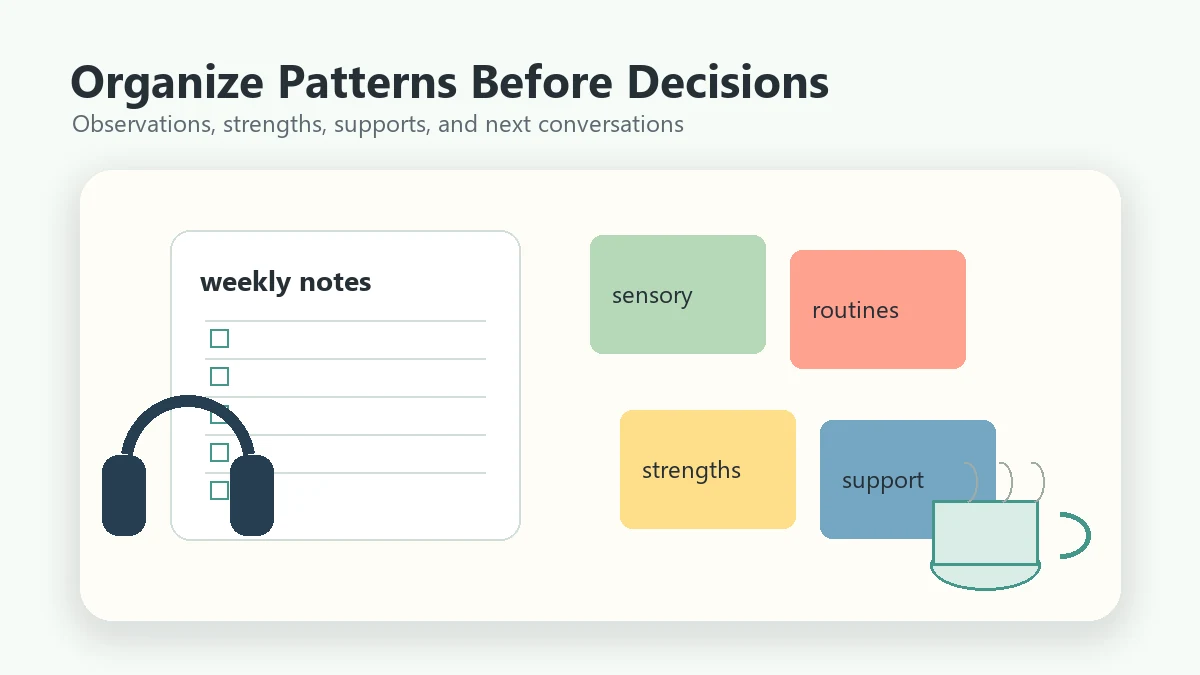
If your real question is "what should I do with this information?", start with observation rather than pressure. Write down situations that are hard, supports that help, strengths that show up consistently, and patterns that have been present over time. For a child, include school, home, sleep, sensory, communication, and peer contexts. For an adult, include work, relationships, burnout, masking, routines, sensory load, and independent living tasks.
Then decide what kind of answer you need. A workplace accommodation question may need different evidence than a school support request. An SSI application may need more detailed documentation than a personal self-reflection process. A medical or mental health concern should be discussed with qualified professionals who can look at the full picture, including co-occurring conditions.
For a gentle starting point, a structured autistic test can help you organize traits before deeper conversations. Treat the result as one piece of reflection, not a final label. Autism can be a disability, a neurodevelopmental difference, an identity, a support category, and a legal concept at the same time. The most respectful answer leaves room for the person's actual life.
FAQ
Does autism qualify as disabled?
Autism can qualify as a disability when it creates substantial functional limitations or meets the definition used by a specific law, school system, workplace rule, or benefit program. The answer depends on the person's support needs and the rule being applied.
Is autism a disability or mental illness?
Autism is generally understood as a neurodevelopmental condition, not a mental illness. Autistic people can also have mental health conditions such as anxiety or depression, but those are separate from autism itself.
What level of disability is autism?
Autism is often described by support levels, commonly Level 1, Level 2, and Level 3. These levels describe support needs, not personal value or ability. Disability programs may use their own criteria rather than autism support levels alone.
Is high-functioning autism considered a disability?
It can be. The phrase "high-functioning" may overlook hidden effort and support needs. A person who communicates well or succeeds academically can still need accommodations for sensory overload, transitions, social communication, or daily functioning.
Is autism a disability for SSI?
Autism can qualify for SSI when the person meets both the program's disability standard and financial rules. Approval is not automatic, and payment amounts vary by income, living arrangement, state supplements, and other factors.
Is autism a disability for tax purposes?
Sometimes, but there is no single autism-only tax rule. Tax treatment depends on the specific rule, expense, dependent status, and documentation. Families should use current IRS guidance or a qualified tax professional for their exact situation.
Can you live a normal life on the spectrum?
Many autistic people build full, meaningful lives with different combinations of independence, community, accommodations, therapy, routines, and support. "Normal" is less useful than asking what environment helps the person communicate, recover, learn, work, and participate safely.