Can You Grow Out of Autism: The Reality of Lifelong Neurodivergence
Have you ever wondered if an autism diagnosis from childhood is still relevant today? Or perhaps you are a parent witnessing your child make such significant strides that the label "autistic" no longer seems to fit.
It is a question that brings both hope and confusion. You see the changes, the adaptations, and the new skills. Naturally, you might ask: Can you grow out of autism?
The short answer is no, you do not grow out of autism, but you do grow into who you are. Autism is a lifelong neurodevelopmental difference, not a childhood illness that fades away. However, how autistic traits manifest can change drastically over time.
This guide will help you understand why symptoms seem to disappear, the hidden role of masking, and what it truly means to live with a neurodivergent brain in a neurotypical world. We will also explore educational tools like our autism spectrum test to help you understand your current profile.
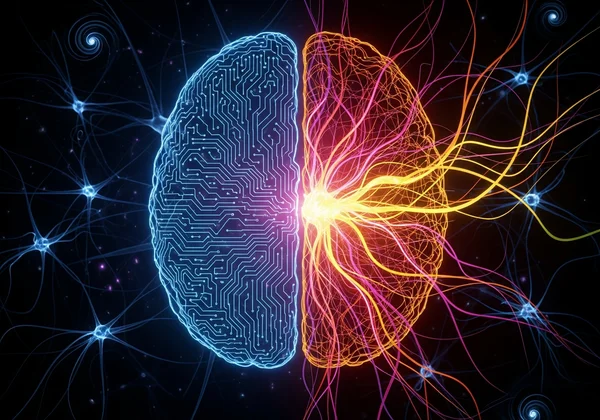
The Neurological Reality: Is Autism a Lifelong Condition?
To understand why you cannot simply "grow out" of autism, we first need to look at what autism actually is. It is not a behavioral problem or a temporary developmental delay; it is a distinct way the brain is wired.
Research consistently shows that autism is a lifelong condition. The neural pathways established during development create a permanent foundation for how an autistic person processes information, sensory input, and social interactions.
Understanding Brain Wiring vs. Curable Illness
Think of autism like the operating system of a computer, rather than a glitch in the software. You can upgrade the apps (skills), improve the processing speed (coping strategies), and change the interface (behavior), but the underlying operating system remains the same.
Because it is biological and structural, there is no "cure" for autism. It does not vanish when you turn 18. The core characteristics—such as differences in social communication and sensory processing—remain part of your neurological makeup throughout your lifespan.
Why Adaptation is Often Mistaken for "Curing"
So, why does it often look like someone has been cured? The answer lies in adaptation. Humans are incredibly adaptable.
As autistic children grow, they learn. They acquire language, they observe social rules, and they develop intellectual workarounds for tasks that do not come naturally. An outsider might see a "reduction in symptoms," but the autistic individual experiences an "increase in skills." The brain is still autistic; it has just become highly skilled at navigating a non-autistic world.
Symptom Evolution: "Growing Out" vs. "Growing Into"
While the core neurotype remains constant, the outward expression of autism is fluid. Can you grow out of autism symptoms? In a literal sense, no, but symptoms certainly evolve.
What looks like "outgrowing" is often a shift in how traits are expressed. A behavior that was obvious in a toddler often transforms into a subtle, internal experience in an adult.
From Non-Verbal to Fluent: Language Development
One of the most dramatic changes can occur in communication. Many children diagnosed with non-verbal autism or significant speech delays go on to develop fluent speech.
However, gaining speech does not mean the underlying communication differences disappear. An adult who was a non-verbal child might now speak perfectly but still struggle with:
- Understanding sarcasm or idioms.
- Knowing when to speak or stay silent in conversations.
- Processing verbal instructions quickly under stress.
The challenge shifts from producing words to interpreting the social nuance behind them.
Do Stimming Behaviors Disappear or Change?
Stimming (self-stimulatory behavior) is another area where evolution happens. A young child might flap their hands or rock back and forth visibly.
As they age, social pressure often forces these behaviors underground. They don't disappear; they become miniaturized.
- Childhood: Hand flapping, spinning, loud vocalizations.
- Adulthood: Toe tapping, skin picking, pen clicking, or mental repetition of phrases.
The need for sensory regulation remains, but the method becomes more socially acceptable—often at the cost of being less effective for regulation.
Childhood Behaviors vs. Adult Coping Mechanisms
To visualize this evolution, look at how the same underlying trait manifests differently over time:
| Underlying Trait | Childhood Expression | Adult Coping Mechanism |
|---|---|---|
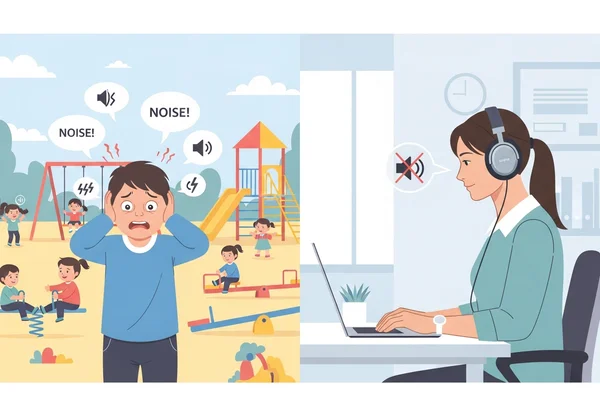
| Sensory Sensitivity | Covering ears, crying at loud noises. | Wearing noise-canceling headphones, avoiding parties, feeling irritable in crowds. |
| Need for Routine | Meltdowns if a toy is moved. | Strict adherence to calendars, anxiety when plans change last minute. |
| Social Differences | Playing alone, ignoring peers. | Memorizing "scripts" for small talk, forcing eye contact despite discomfort. |
| Special Interests | Obsessive lining up of cars. | Deep expertise in a specific career field or hobby, collecting specific items. |
The Masking Effect: Why "Mild" Autism Can Feel Invisible
For many, the question "Can you grow out of mild autism or Asperger's?" stems from the phenomenon of masking. If you were diagnosed with "mild" autism (formerly Asperger's) or High-Functioning Autism, you might feel like your diagnosis is no longer valid because you navigate the world so well.
"Growing Out" of Asperger's or Mild Autism: Is it Possible?
You cannot grow out of Asperger's any more than you can grow out of your eye color. However, individuals with lower support needs are often the most adept at camouflaging their traits.
You might feel "less autistic" because you have intellectualized social interactions. You have learned the rules of the game so well that you pass as neurotypical. But passing is not the same as being. The effort required to maintain this facade is often the definitive proof that the autism is still there.
Social Mimicry and Scripting Explained
Masking involves consciously or unconsciously suppressing natural autistic instincts. This performance can be so convincing that friends, partners, and even some professionals might doubt your diagnosis.
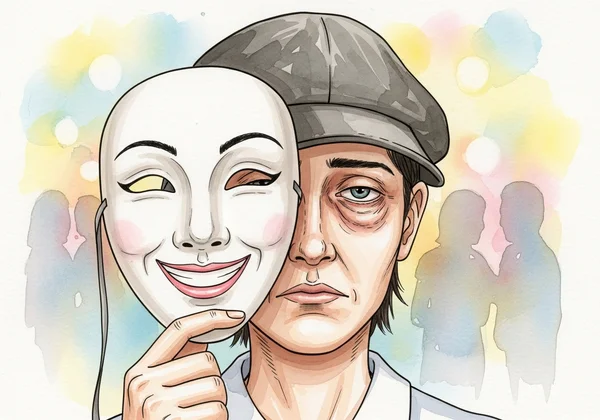
Checklist: Are You Masking or "Cured"? If you relate to the following, you are likely masking, not outgrowing the condition:
- Forced Eye Contact: Do you look at people's eyebrows or noses to fake eye contact?
- Scripting: Do you rehearse conversations in the shower or car before having them?
- Mimicry: Do you adopt the accent, posture, or slang of the person you are talking to just to fit in?
- Post-Social Crash: Do you feel physically exhausted or need to sleep after a standard social gathering?
The Hidden Cost: Autistic Burnout
The cost of "growing out" of your symptoms through masking is high. It often leads to Autistic Burnout. This is a state of chronic physical and mental exhaustion caused by the prolonged effort of coping with a world that doesn't match your nervous system.
If you feel like your autism is "coming back" or getting worse in your 30s or 40s, it is likely burnout. You haven't regressed; you have just run out of the energy required to mask.
Losing the Diagnosis: The "Optimal Outcome" Explained
You may have heard of studies where children "lose" their diagnosis. Is this proof that can a child grow out of autism diagnosis?
What Research Says About Losing the Label
Research, such as the study by Fein et al., identified a small group of young people (historically around 9% to 13%) who were diagnosed with autism early in life but no longer met the clinical criteria as they got older. This is sometimes called the "Optimal Outcome."
However, "Optimal Outcome" does not mean their brains rewired themselves to be neurotypical. It means they no longer score high enough on specific diagnostic checklists to qualify for the label.
Why Losing the Diagnosis Doesn't Mean "Cured"
Most of these individuals still retain autistic traits. They might still have sensory quirks or prefer rigid routines, but these traits no longer cause "clinically significant impairment" in their daily lives.
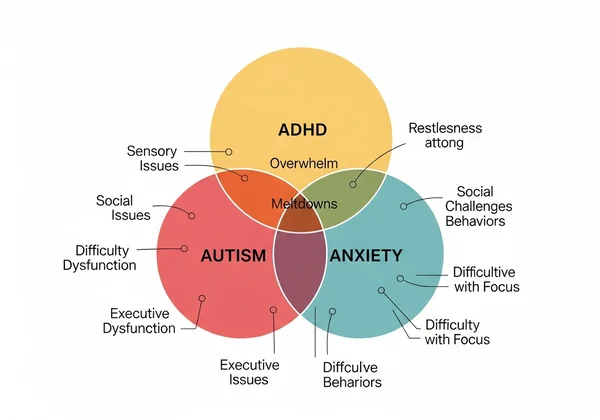
Often, these individuals simply shift categories. They might lose the Autism diagnosis but gain a diagnosis of ADHD, Anxiety, or distinct personality traits. They are still neurodivergent; they just fall outside the specific boundaries drawn by the diagnostic manuals of the time.
Misdiagnosis Factors: When It Wasn't Autism to Begin With
Sometimes, the answer to "Did I grow out of it?" is simply "You never had it." Misdiagnosis is a real possibility, especially with diagnoses made decades ago.
Common Overlaps: ADHD, Anxiety, and Sensory Processing
Several conditions mimic autism, and vice versa.
- ADHD: Shares traits like hyper-focus, social impulsivity, and sensory seeking.
- Sensory Processing Disorder (SPD): Involves sensory sensitivities without the social communication differences of autism.
- Trauma or Anxiety: Can cause withdrawal and rigid behaviors that look like autism in children.
If your symptoms truly disappeared without masking or effort, it is possible the initial label was incorrect. However, for many, it is a mix of both—Autism plus ADHD is a very common combination (AuDHD).
Understanding Your Current Profile: A Path to Self-Discovery
If you are reading this, you are likely in a state of reflection. Maybe you were diagnosed as a child and want to know if it still applies. Or maybe you are an adult who feels different but isn't sure why.
Instead of asking "Did I grow out of it?", a better question is "How does my brain work right now?"
Why Self-Reflection is More Helpful Than Seeking a "Cure"
Chasing the idea of "outgrowing" autism can lead to impostor syndrome. It invalidates your struggles. Accepting that your brain might simply be wired differently allows you to stop fighting yourself.
Understanding your unique profile helps you:
- Identify why certain environments drain you.
- Communicate your needs to partners and employers.
- Move from "fixing" yourself to "accommodating" yourself.
Explore Your Traits with Our Educational Tool
If you are unsure where you stand today, utilizing educational resources can provide clarity. You don't need a medical appointment to start exploring your own mind.
We have designed a specialized tool to help you map out your current traits. It is not a medical diagnosis, but a way to visualize your neurodivergent patterns.

Explore your traits with our online assessment. This tool is designed for self-discovery. It looks at the nuances of adult autism, including masking behaviors that standard checklists often miss. It can be a helpful first step in understanding if those "childhood traits" are actually still present in your adult life.
Embracing Neurodiversity at Any Age
The journey of an autistic individual is not about "growing out" of the condition; it is about growing into a self-assured, supported adult.
Whether you have a formal diagnosis, identify as self-diagnosed, or are just exploring, remember that neurodiversity is a natural variation of the human experience. You do not need to be "cured" to be whole. You simply need to understand the manual for your own brain.
If you find that your traits significantly impact your daily life or cause distress, consider referencing your autistic test results when speaking with a neurodiversity-affirming therapist.
Frequently Asked Questions
Does autism get worse with age?
Autism itself is not degenerative; it does not get worse biologically. However, the demands of adult life (jobs, bills, relationships) can exceed a person's coping capacity, leading to increased stress or burnout. This can make symptoms appear more severe than they were in childhood.
Can early intervention cure autism?
No, early intervention (like speech therapy or OT) is not designed to cure autism. Its goal is to provide the child with skills to navigate the world and communicate effectively. A child who receives intervention is still autistic, but they may face fewer barriers in daily life.
Can mild autism go away completely?
"Mild" autism (often historically called Asperger's) does not go away. Individuals with this profile are often highly intelligent and capable of learning complex social masking strategies. This can make the autism invisible to others, but the internal experience of being autistic remains.
Is it possible I was misdiagnosed?
Yes, it happens. Conditions like ADHD, severe anxiety, or attachment disorders can mimic autistic traits in childhood. If you feel you have absolutely no autistic traits as an adult—even internally—it is worth exploring if the original diagnosis was accurate or if another neurodivergent profile fits better.
Do stimming behaviors ever disappear?
Rarely. Stimming is a regulation mechanism for the nervous system. While obvious stims like spinning might stop due to social conditioning, they are usually replaced by subtler movements like leg bouncing, finger tapping, or mental repetition. The need to stim usually persists for life.