Autism Spectrum Disorder Symptoms in Infants Every Parent Should Know
Autism spectrum disorder symptoms in infants can be subtle, and many parents wonder whether what they are noticing is typical development or something that deserves closer attention. If you have been watching your baby and feeling that something seems different — perhaps in how they respond to your voice, make eye contact, or interact during play — you are not alone.
Early awareness matters. Research consistently shows that recognizing autism spectrum disorder symptoms in infants early can open the door to interventions that meaningfully support a child's development. This guide covers the key signs to watch for at different stages, how to tell the difference between normal variation and potential red flags, what screening tools are available, and what steps to take if you have concerns. You will also find practical checklists and answers to frequently asked questions from parents just like you.
What Is Autism Spectrum Disorder and Why Early Detection Matters
Autism spectrum disorder (ASD) is a neurodevelopmental condition that affects how a person communicates, interacts socially, and processes sensory information. It is called a "spectrum" because it presents differently in every individual — some children may show very noticeable differences early on, while others may display subtler patterns that emerge gradually.
Why the First Two Years Are Critical
The brain develops rapidly during infancy. During this window, neural pathways for communication, social bonding, and sensory processing are actively forming. When autism spectrum disorder symptoms in infants are identified early, targeted support — such as speech therapy, occupational therapy, or developmental play interventions — can work alongside the brain's natural growth patterns.
Early intervention does not "cure" autism. However, it can significantly improve outcomes in communication, social skills, and adaptive behavior. According to developmental research, children who receive support before age three often show greater progress than those who begin intervention later.
How Common Is ASD in Infants
Current estimates suggest that approximately 1 in 36 children are identified with autism spectrum disorder. While a formal diagnosis is typically made around age two or later, many behavioral patterns associated with ASD can be observed in infancy — sometimes as early as six months of age.
Key Autism Spectrum Disorder Symptoms in Infants Under 12 Months
Not every baby develops at the same pace, and occasional variations are perfectly normal. However, certain patterns — especially when several appear together — may warrant closer observation. Below are the most commonly recognized signs to watch for during the first year.
Limited or Absent Eye Contact
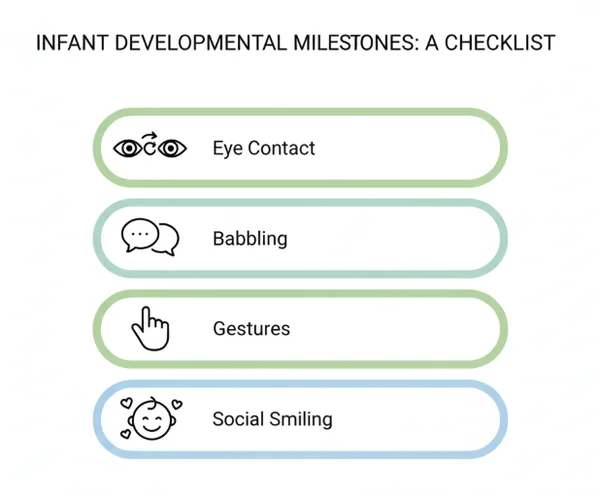
Most infants begin making eye contact within their first few weeks and use it increasingly to connect with caregivers. A baby who consistently avoids eye contact, or who rarely looks at your face during feeding, play, or conversation, may be showing one of the early markers associated with ASD.
Not Responding to Their Name
By around nine months, most babies turn their head or look toward a caregiver when their name is called. If your infant consistently does not respond to their name — even when there are no distractions — it may be worth discussing with your pediatrician.
Reduced Social Smiling
Babies typically develop a social smile by around two months of age. They smile when they see a familiar face and often smile in response to someone smiling at them. An infant who rarely smiles during social interactions, or who does not smile back when you smile at them, may be showing a sign worth noting.
Limited Babbling and Vocalization
By six to nine months, most babies babble, coo, and experiment with sounds. A noticeable delay in babbling — or sounds that seem more like whining and humming rather than typical speech-like sounds — can be an early indicator. The absence of babbling by 12 months is considered a potential red flag.
Few or No Gestures
Pointing, waving, clapping, and reaching are important communicative milestones. Most babies begin using gestures between nine and twelve months. If your infant is not waving bye-bye, pointing to things they want, or reaching up to be held by 12 months, this is a pattern to discuss with a healthcare provider.
Unusual Reactions to Sensory Input
Some infants with ASD may show heightened sensitivity to certain sensory experiences — such as becoming very distressed by loud sounds, bright lights, or specific textures. Conversely, others may show unusually low sensitivity, seeming not to notice pain or extreme temperatures.
Signs That May Become Clearer Between 12 and 24 Months
As babies grow into toddlers, additional autism spectrum disorder symptoms may emerge or become more apparent. Some children who seemed to be developing typically may show a regression in skills they previously had.
Delayed or Lost Speech
Some toddlers with ASD develop a few words and then stop using them. Others may not begin speaking when expected. By 16 months, most children can say at least a few single words. By 24 months, most can combine two words together. Significant delays in these milestones, or loss of words a child previously used, should be discussed with a professional.
Limited Pretend Play
By 18 months, many children begin engaging in simple pretend play — feeding a doll, talking on a toy phone, or pretending to cook. A toddler who shows little interest in imaginative play, or who only uses toys in repetitive ways (such as spinning wheels or lining objects up), may be displaying a pattern associated with ASD.
Repetitive Movements and Behaviors
Repetitive behaviors — often called "stereotypies" — can include hand-flapping, body rocking, spinning, or toe-walking. While some repetitive behaviors are common in all toddlers, persistent and unusual repetitive movements, especially combined with other signs, can be a marker of ASD.
Strong Resistance to Routine Changes
Many toddlers enjoy routine, but children on the autism spectrum may become extremely distressed when their usual routines are disrupted. If your child reacts intensely to minor changes in daily patterns — such as a different path to the park or a new cup at mealtime — this is worth observing over time.
Preference for Solitary Play
While parallel play (playing alongside but not with other children) is typical at this age, a toddler who consistently avoids interacting with peers, does not show interest in other children, and rarely brings toys to share with a caregiver may be exhibiting a social pattern associated with ASD.
How to Tell the Difference Between Normal Variation and a Red Flag
Every child develops at their own pace. A baby who is a late talker is not necessarily on the autism spectrum, and a toddler who loves lining up blocks may simply enjoy patterns. So how do you know when to be concerned?
Look for Clusters, Not Single Signs
A single behavior in isolation is rarely cause for alarm. Developmental specialists look for clusters of signs — for example, limited eye contact combined with delayed babbling and few gestures. The more signs you observe together, the more important it becomes to seek a professional opinion.
Track Changes Over Time
Keep notes on your child's behavior and milestones. If you notice that your baby is not meeting several developmental milestones — or if skills that were present seem to fade — documenting these changes can be extremely helpful when you speak with your pediatrician.
Trust Your Instincts
Parents often notice subtle differences before anyone else does. If something feels "off" to you, that feeling is worth exploring. You do not need to wait for a certain age or a specific number of missed milestones to ask questions.
What Screening Tools Are Available for Infants and Toddlers
Several validated screening tools can help identify children who may benefit from a more thorough evaluation.
M-CHAT-R (Modified Checklist for Autism in Toddlers, Revised)
The M-CHAT-R is one of the most widely used screening tools for autism in children between 16 and 30 months of age. It consists of 20 yes-or-no questions about your child's behavior. While it is not a diagnostic tool, a high score on the M-CHAT-R suggests that a comprehensive evaluation may be helpful.
Developmental Pediatrician Assessments
If screening results suggest further evaluation, a developmental pediatrician can conduct a comprehensive assessment. This may include direct observation, structured play-based evaluation, parent interviews, and standardized developmental tests.
Online Screening Resources
Online tools can offer a helpful starting point for parents who want to organize their observations before speaking with a healthcare professional. For instance, exploring a resource like the autism spectrum screening tool at AutisticTest.org can help you reflect on your child's behavioral patterns in a structured, private setting. These tools are designed for educational self-exploration, not as substitutes for professional evaluation.

What to Do If You Notice Signs of Autism in Your Baby
Recognizing potential signs can feel overwhelming. However, taking action early gives your child the best possible foundation for development.
Step 1 — Document What You Observe
Write down the specific behaviors you have noticed, when they occur, and how often. Include examples from daily routines like feeding, playtime, and social interactions. This information will be valuable for healthcare providers.
Step 2 — Talk to Your Pediatrician
Share your observations with your child's doctor. Be specific. Rather than saying "something seems off," describe exactly what you have noticed — for example, "She does not look at me when I call her name, and she has not started babbling at 10 months."
Step 3 — Request a Developmental Evaluation
If your pediatrician shares your concerns, they may refer you to a developmental specialist. You can also contact your local early intervention program directly — in many regions, you do not need a referral.
Step 4 — Begin Early Intervention Services
If your child qualifies for early intervention, services may include speech therapy, occupational therapy, behavioral support, and developmental play therapy. These services are often available at no cost or reduced cost for families of young children.
Step 5 — Connect With Other Parents
Joining a parent support group — either locally or online — can provide emotional support, practical advice, and a sense of community. Many parents find that connecting with others who understand their experience makes a meaningful difference.
Understanding That a Screening Is Not a Diagnosis
It is important to remember that screening tools and online resources are starting points, not definitive answers. A positive result on a screener does not mean your child has autism spectrum disorder. It means further evaluation by a qualified professional is recommended.
Similarly, if your child does receive a diagnosis, it is not a limitation. Many people on the autism spectrum lead fulfilling, accomplished lives. A diagnosis can actually be empowering — it opens doors to specific support, helps families understand their child's unique needs, and provides a framework for building on strengths.
If you are exploring your child's developmental patterns and want a structured way to reflect on what you have observed, an educational autism screening resource can help you organize your thoughts before your next conversation with a professional.
Key Takeaways for Parents Watching for Autism Spectrum Disorder Symptoms in Infants
- Early signs can appear before age one. Limited eye contact, reduced social smiling, delayed babbling, and few gestures are among the earliest indicators.
- Look for patterns, not single behaviors. A cluster of signs is more meaningful than any one behavior in isolation.
- Trust your observations. Parents are often the first to notice subtle developmental differences.
- Screening tools are helpful starting points. They help organize your concerns before seeking professional evaluation.
- Early intervention makes a difference. Support during the first few years can significantly improve communication, social skills, and adaptive behavior.
- A screening is not a diagnosis. Only a qualified professional can diagnose autism spectrum disorder after a comprehensive evaluation.
Your awareness and willingness to pay attention are among the most important gifts you can give your child. If you have noticed behaviors that concern you, take the first step — talk to your pediatrician, explore your observations with a trusted screening tool, and know that seeking answers is an act of love and care.
This article is for educational and informational purposes only. It is not intended as medical advice or a substitute for professional evaluation. If you have concerns about your child's development, please consult a qualified healthcare provider.
Frequently Asked Questions
At what age can autism spectrum disorder symptoms first appear in infants?
Some signs may be noticeable as early as six months of age, though many symptoms become clearer between 12 and 24 months. Early indicators include limited eye contact, reduced social smiling, and delayed babbling.
Can a baby show signs of autism and still develop typically?
Yes. Some early behaviors that resemble autism signs may resolve as a child grows. However, if you observe multiple signs together, it is best to seek a professional evaluation rather than waiting to see if they resolve on their own.
Is it possible to diagnose autism in infants under one year old?
A formal diagnosis is typically made around age two or later. However, screening tools and developmental evaluations can identify risk factors in infants under 12 months, which may lead to earlier monitoring and support.
What should I do if my pediatrician dismisses my concerns?
Trust your instincts. If you feel your concerns are not being taken seriously, seek a second opinion from a developmental pediatrician or contact your local early intervention program directly for an independent evaluation.
Are online autism screening tools reliable for infants?
Online screening tools can be useful for organizing your observations, but they are not diagnostic. They work best as a first step before speaking with a qualified healthcare professional who can conduct a comprehensive assessment.
Does early intervention guarantee improved outcomes?
Early intervention does not guarantee specific outcomes, but research consistently shows it can significantly improve communication, social skills, and adaptive functioning. Starting support during the early developmental window gives children the best opportunity to build on their strengths.